What Are Blenders and Food Processors?
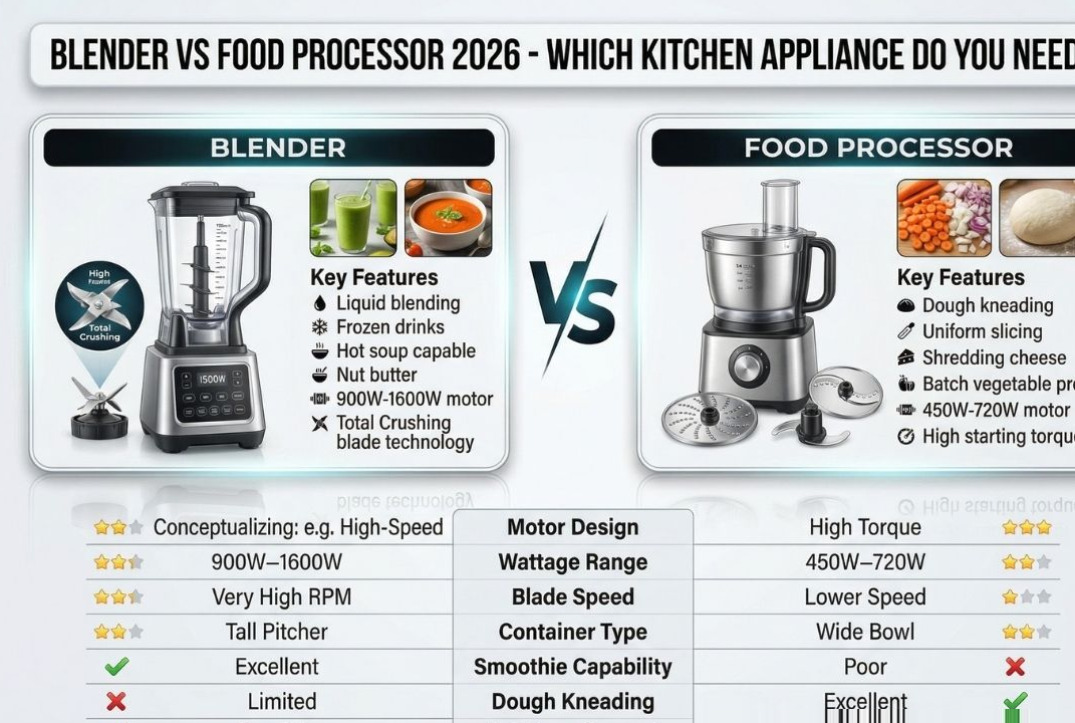
Blenders and food processors are designed for opposite tasks: blenders excel at liquid and semi-liquid ingredients processed at high speed in a pitcher, while food processors excel at solid food tasks like chopping, slicing, and dough mixing using interchangeable blades in a bowl. The fundamental difference is blade design and motor placement, which determines what each appliance does well and where each one fails.
A blender uses a single blade assembly at the bottom of a pitcher, driven by a motor in the base below. The blade spins at high speed (typically 1,000 to 15,000 RPM in consumer models) to break down liquid and semi-liquid ingredients into smooth textures. The pitcher design creates a vortex that draws ingredients down toward the blade, which is why blenders excel at smoothies, shakes, soups, and sauces. The high-speed vortex is also what makes blenders capable of crushing ice and frozen fruit, which a food processor cannot do.
A food processor uses interchangeable blade and disc attachments in a wide bowl, driven by a motor in the base below the bowl. The motor spins at lower speeds (typically 400 to 1,000 RPM) with more torque, which is why food processors excel at tasks that require controlled cutting rather than high-speed liquid processing. The wide bowl and low-speed motor make food processors ideal for slicing vegetables uniformly, chopping nuts to specific consistencies, shredding cheese, and kneading dough without generating the friction heat that a blender would produce.
Blender Design and Motor Architecture
Blender motors are engineered for high rotational speed rather than high torque. The motor spins the blade assembly at speeds ranging from 1,000 RPM (lowest speed on most models) to 15,000 to 25,000 RPM on premium models like the Ninja BN701 at 1400W. The high blade speed creates the vortex effect that draws liquid ingredients into the blade path continuously, which is why blenders produce smooth, uniform textures on liquid-based tasks. The trade-off is low torque at startup and under heavy load, which is why blenders stall on dense dough mixtures that require sustained rotational force.
Consumer blenders like the Ninja BL770 at 1500W and the Ninja BL642 at 1200W use BPA-free Tritan pitchers ranging from 64oz to 72oz. The wide-mouth pitcher design makes pouring easy and the self-cleaning function handles most residue in under 60 seconds with warm water and dish soap. Personal blenders like the NutriBullet Pro at 900W use cup-to-base design with 18oz to 32oz cups that serve as both blending vessels and drinking containers.
Food Processor Design and Blade System
Food processor motors are engineered for high starting torque rather than high rotational speed. The motor delivers strong rotational force at low speeds, which is why food processors can knead stiff bread dough without stalling and slice vegetables uniformly without turning them into puree. The bowl design holds 8 to 17 cups of ingredients, which is significantly larger than any blender pitcher for batch food prep tasks.
The Cuisinart DFP-17BCY at 720W with a 17-cup bowl is the premium home food processor option, large enough to process a whole chicken or knead dough for four loaves of bread in a single batch. The Ninja FF302 Foodi 8-in-1 at 600W covers the mid-range with disc and blade attachments for slicing, shredding, dough, and chopping. Both use stainless steel S-blade and disc attachments that are removable and dishwasher-safe, which makes cleanup faster than blender pitchers for solid food tasks.
Where the Two Appliances Overlap
The overlap between blenders and food processors is narrower than manufacturers suggest with hybrid marketing. Both can chop nuts and make breadcrumbs, but the results differ significantly. A blender produces a coarser, less uniform chop on nuts because the high-speed blade creates more fragmentation than controlled cutting. A food processor produces a perfectly uniform chop because the S-blade and lower speed create controlled cutting. Both can make hummus, but a blender requires more liquid to process and produces a smoother texture, while a food processor produces a more textured spread with better ingredient control.
Performance Across Key Tasks
Blenders dominate on liquid tasks: smoothies, shakes, frozen fruit, hot soup, and sauces. Food processors dominate on solid tasks: chopping, slicing, shredding, kneading, and emulsifying. Neither does both well, which is why the hybrid question is more relevant than the superiority question.
The task comparison reveals why hybrid models like the Ninja BL770 make sense for many kitchens. If you regularly make both smoothies and salsa, the hybrid eliminates the need for two separate appliances. If you make primarily one type of task, the dedicated appliance is more capable than the hybrid equivalent.
Smoothies, Shakes, and Liquid Blending
Blenders win this category decisively. The high-speed blade and pitcher vortex design is specifically engineered for liquid processing, which is why the Ninja BL770 at 1500W, the Ninja BL642 at 1200W, and the NutriBullet Pro at 900W all produce smooth, uniform smoothies in under 60 seconds. The pitcher design allows ice, frozen fruit, liquid, and protein powder to circulate through the blade path continuously, which produces a consistent texture without over-processing.
A food processor can make a rough smoothie using the S-blade, but the lower speed and wide bowl design mean ingredients settle at the bottom and the blade misses chunks near the bowl walls. The result is an uneven texture that requires more liquid and more processing time than a blender produces in a single cycle.
Dough, Salsa, and Solid Food Processing
Food processors win this category decisively. The Cuisinart DFP-17BCY at 720W kneads bread dough for four loaves in a single batch, produces uniform pie crust in under a minute, and shreds cabbage for coleslaw with clean, even strips. The S-blade at low speed creates the controlled cutting motion that produces uniform dice on onions, peppers, and tomatoes for salsa without the liquid extraction that a blender would cause.
The Ninja FF302 Foodi 8-in-1 at 600W covers the mid-range food processor tasks with disc attachments for 4mm slicing and 4mm shredding, which handles the most common home food prep tasks. The 8-cup bowl is large enough for family meal prep without being unwieldy for daily tasks like chopping onions or mincing garlic.
Nut Butter and Hot Soup Capability
Blenders at 1200W+ can make nut butter from raw almonds, cashews, and peanuts through extended high-speed processing. The process takes 5 to 10 minutes of continuous blending and generates enough friction heat to warm the finished butter slightly. Hot soup is the clearest blender advantage: the Vitamix and high-wattage Ninja models at 1200W+ generate friction heat sufficient to bring vegetable soup to steaming temperature in under 6 minutes, which no food processor can replicate.
Food processors cannot make nut butter at any wattage because the lower blade speed and different blade geometry do not generate the sustained friction required to break down raw nuts into smooth butter. Food processors also cannot make hot soup because the motor is not designed for the sustained high-speed operation that generates friction heat.
Best Use Cases for Each Appliance
When a Blender Is the Better Choice
A blender is the better choice for households that prioritize smoothies, protein shakes, frozen drinks, hot soup, and sauces. The Ninja BL770 Kitchen System at 1500W is the practical best choice for households that want both blender and food processor capability in one package, with the 72oz pitcher handling family smoothies and the 8-cup food processor bowl handling salsa, dough, and vegetable prep. For households that want pure blending capability, the Ninja BL642 at 1200W with Auto-iQ delivers the best value in the countertop blender tier.
For solo users who prioritize portability and single-serve smoothies, the NutriBullet Pro at 900W delivers the cup-to-base convenience that makes morning protein shakes and green smoothies effortless.
When a Food Processor Is the Better Choice
A food processor is the better choice for households that prioritize batch food prep, baking, and controlled solid-food processing. The Cuisinart DFP-17BCY at 720W with a 17-cup bowl is the premium home food processor for serious home cooks who bake bread, make pie crust from scratch, or process large quantities of vegetables for meal prep. The large bowl capacity eliminates the need for batch processing on big cooking tasks.
Hybrid Models That Do Both
The Ninja BL770 Kitchen System at 1500W is the most capable hybrid available: the 72oz blender pitcher handles smoothies, frozen drinks, and hot soup, while the 8-cup food processor bowl handles salsa, dough, and vegetable prep using the same motor base. This eliminates the need for two separate appliances in kitchens with limited counter and storage space. See our best blenders 2026 roundup for hybrid model rankings.
Which Should You Buy?
Buy a blender if smoothies, protein shakes, frozen drinks, and hot soup are your primary tasks. Buy a food processor if chopping, slicing, shredding, and dough mixing are your primary tasks. Buy the Ninja BL770 hybrid if you do both regularly and want one appliance that handles everything without compromise.
The appliance choice depends on honest assessment of your actual cooking patterns. If your weeknight routine is a morning smoothie and an evening protein shake, a blender is all you need. If your weekend routine involves baking bread, making salsa from scratch, and shredding cabbage for coleslaw, a food processor earns its counter space. If you do both, the hybrid is the practical solution.
Kitchen Space and Storage
Blenders store in a cabinet or on the counter permanently. Food processors with large bowls like the Cuisinart DFP-17BCY require more cabinet space and are typically stored disassembled between uses. The Ninja BL770 hybrid eliminates storage redundancy by combining both functions in one motor base, which matters for small kitchens where counter space and cabinet space are both limited.
Price and Value Comparison
Entry-level blenders start in the range under $100, with capable models like the Ninja BL610 at 1000W delivering genuine countertop performance. Food processors start in the same price range, with capable models like the Hamilton Beach 10-Cup at 450W covering basic chopping and slicing tasks. The premium tiers diverge significantly: a high-wattage blender at 1200W to 1500W costs roughly the same as a large-bowl food processor at 700W to 720W, which means the choice is less about budget and more about which tasks you actually perform.
Cleaning and Maintenance Effort
Blenders clean fastest for liquid tasks: the self-cleaning function on most models handles pitcher residue in under 60 seconds with warm water and dish soap. Food processors have more attachments (S-blade, multiple discs, dough paddle) that require individual hand-washing or top-rack dishwasher placement. The cleanup complexity favors blenders for households that prioritize quick post-use cleaning.
Frequently Asked Questions
Can a blender do everything a food processor does?
No. A blender cannot knead dough, slice vegetables uniformly, or shred cheese to consistent results. A blender can chop nuts and make rough breadcrumbs, but the high-speed blade produces less uniform results than a food processor’s S-blade at lower speed. See our best blenders 2026 guide for pure blender recommendations.
Can a food processor make smoothies?
A food processor can produce a rough blended drink, but not a smooth smoothie. The lower blade speed and wide bowl design prevent the vortex effect that draws ingredients into the blade path continuously. The result is an uneven texture with chunks settled at the bottom. For smoothies, a blender is the only capable option.
Which is better for making salsa?
A food processor produces better salsa for chunky, restaurant-style results. The S-blade at low speed creates controlled chopping that produces uniform dice on tomatoes, onions, and peppers without extracting excess liquid. A blender produces smoother salsa more quickly but lacks the texture control that a food processor delivers.
Can a blender knead dough?
No blender at any wattage can knead bread dough effectively. Dough requires high starting torque at low speed, which is the opposite of what blender motors are designed for. Blenders stall on dense dough mixtures and the high-speed blade cuts through dough rather than kneading it. A food processor is the only capable option for dough mixing and kneading.
Which is easier to clean?
A blender is easier to clean for liquid tasks. The self-cleaning function handles most pitcher residue in under 60 seconds with warm water and dish soap. Food processors have more attachments to disassemble and clean individually, which adds cleanup time. For quick daily use, blenders have a practical advantage.
Do I need both a blender and a food processor?
You need both if you regularly perform both liquid tasks (smoothies, shakes, hot soup) and solid food tasks (dough, slicing, shredding). If one type of task dominates your cooking, a dedicated appliance is more capable than a hybrid at the same price. See our best blender for smoothies guide and best immersion blender guide for dedicated appliance options.
Verdict
Choose a blender if smoothies, protein shakes, frozen drinks, and hot soup are your priority. The Ninja BL770 Kitchen System at 1500W handles both blending and food processing in one package, which is the practical choice for most households that want versatility without two separate appliances. For pure blending capability, the Ninja BL642 at 1200W delivers the best value in the countertop tier. Choose a food processor if batch cooking, baking, and controlled solid-food processing are your priority — the Cuisinart DFP-17BCY at 720W with its 17-cup bowl handles every food processor task at the home kitchen level.
The blender vs food processor decision rewards honest cooking pattern assessment. If your routine is smoothies and protein shakes, a blender is the right investment. If your routine is chopping, slicing, and baking, a food processor earns its counter space. If you do both, the hybrid eliminates the dilemma entirely.
See best blenders 2026 roundup
See best blender for smoothies guide
This article contains Amazon affiliate links. We may earn a commission when you purchase through links on this page, at no extra cost to you. See our affiliate disclosure for more information.