Catch Hot Deals reviews and compares blenders by matching each recommendation to a real buyer task, checking the evidence behind the claim, and reviewing the Amazon listing before a shopper clicks away from the site. This methodology supports our blender buying guides, comparison pages, and product reviews for US shoppers.
The goal is simple: a blender recommendation should explain why a model fits a use case, what evidence supports that recommendation, what still needs verification, and how affiliate links are disclosed. If a page says a blender was tested, that claim must be backed by visible first-party proof. If the page is based on research, specs, owner feedback, or listing checks, the wording should say that clearly.
Affiliate disclosure: Catch Hot Deals may earn from qualifying Amazon purchases. Affiliate links do not decide which blenders belong on a recommendation page, and Amazon prices, availability, ratings, and listing details can change.
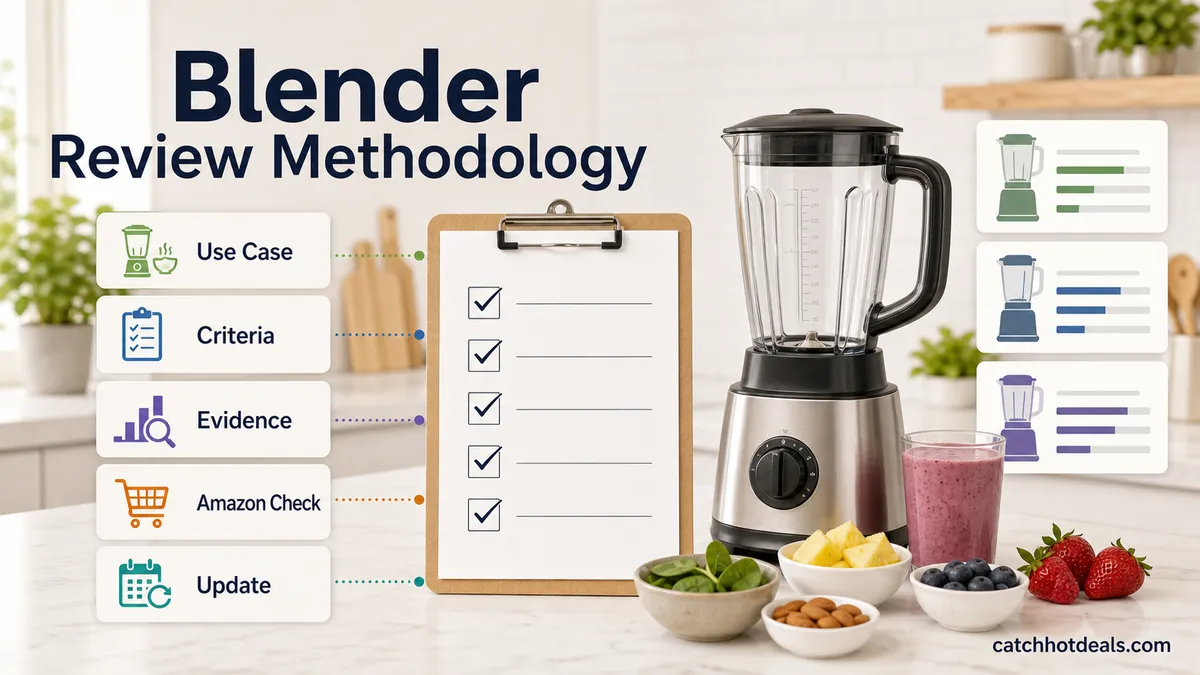
What Does Our Blender Review Methodology Cover?
Our blender review methodology covers buyer fit, blender criteria, evidence level, Amazon listing checks, update triggers, and affiliate disclosure. Each part helps a shopper understand whether a recommendation is useful before opening a product page.
The method focuses on six review signals:
- Use-case fit: The blender should match the shopper’s main job, such as smoothies, ice, frozen fruit, nut butter, soup, family batches, or small-kitchen use.
- Criteria fit: The recommendation should explain motor power, jar size, blade design, controls, cleanup, noise, warranty, durability, and value when those attributes affect the decision.
- Evidence level: The page should separate hands-on testing from reviewed, compared, researched, or listing-checked claims.
- Amazon listing check: The product URL, model identity, included parts, seller/availability signals, and CTA language should be reviewed before publishing.
- Update path: The guide should change when models, listings, availability, internal links, or evidence change.
- Disclosure path: The page should make affiliate monetization clear instead of hiding it behind the buying advice.
This methodology supports the best blenders guide and the broader blender buying guide. Those pages make the buying decision; this page explains the trust system behind the recommendation.
Which Blender Review Criteria Matter Most?
The most important blender review criteria are the criteria that change buyer fit. A smoothie buyer, a family-batch buyer, and a frozen-fruit buyer should not be judged by one generic "best blender" standard.
| Criterion | What It Shows | Why It Matters | Evidence Needed |
|---|---|---|---|
| Use-case fit | Whether the blender matches the main task | A compact smoothie cup and a premium countertop blender solve different problems | Buyer scenario, product specs, comparison logic |
| Smoothie texture | Whether blended drinks stay smooth enough for daily use | Smoothie shoppers care about frozen fruit, protein powder, and leafy greens | Test proof if claimed; otherwise researched comparison |
| Ice and frozen fruit | Whether the blender can handle hard or frozen loads | Ice and dense frozen fruit stress the motor, jar, and blade system | Test proof or clearly labeled evidence source |
| Motor and control | How power, torque, pulse, and speeds support the task | Watts alone do not prove performance | Specs plus task explanation |
| Jar capacity and material | How serving size, storage, and handling fit the kitchen | A personal cup and a 64 oz pitcher serve different users | Specs and buyer-use explanation |
| Cleanup and noise | How the blender feels to own every day | A hard-to-clean or loud blender can be a poor daily fit | Owner feedback, specs, or first-party notes |
| Durability and support | Whether warranty, parts, and build quality support longer ownership | A blender is a repeated-use appliance, not a one-click purchase | Warranty/support information |
| Value for money | Whether the price tier makes sense for the task | A premium blender is not always necessary, and a cheap blender is not always cheaper long term | Budget tier and use-case comparison |
| Amazon listing confidence | Whether the product page matches the recommendation | Amazon listings can change by seller, bundle, model, or stock state | Direct Amazon listing check before publishing |
For a shopper who is still choosing by feature, the how to choose the best blender guide explains how these criteria become a buying decision. For smoothie-first shoppers, the best blender for smoothies guide applies the same criteria to texture, frozen fruit, and daily cleanup.
How Do We Separate Tested, Reviewed, And Researched Claims?
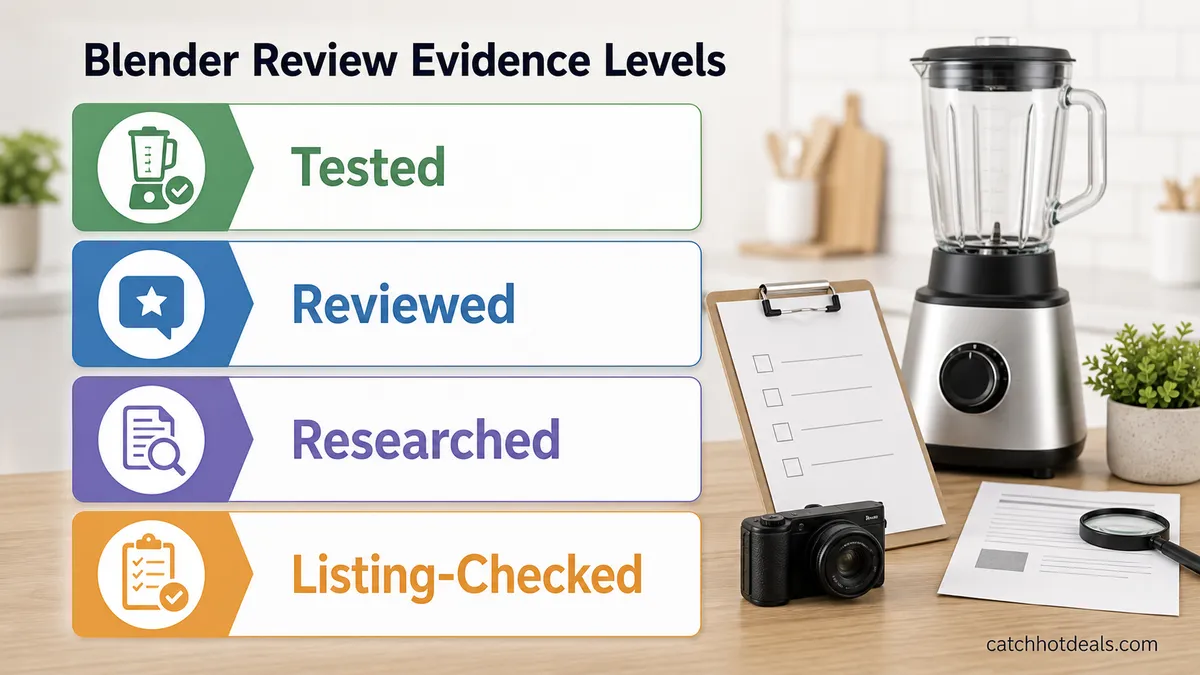
"Tested" means Catch Hot Deals has visible first-party proof for the claim. If that proof is missing, the page should use safer wording such as reviewed, compared, researched, source-checked, or listing-checked.
| Evidence Level | Allowed Wording | Required Proof | Do Not Say |
|---|---|---|---|
| Tested | Tested, hands-on tested, measured | Test date, products tested, method, photos or score sheet, repeatable criteria | Do not say tested if the proof is not visible. |
| Reviewed | Reviewed, evaluated, assessed | Product specs, listing data, owner feedback, editorial comparison, disclosed limitations | Do not imply hands-on testing without proof. |
| Compared | Compared, ranked by criteria, matched by use case | Criteria table, sibling products, buyer scenarios, tradeoff explanation | Do not rank by brand reputation alone. |
| Researched | Researched, source-checked, specification-checked | Manufacturer details, retailer listing details, credible review signals, internal notes | Do not present research as lab performance. |
| Listing-checked | Amazon listing checked, current listing reviewed | Exact product URL, model identity, included parts, availability/seller signals at time of review | Do not state permanent price or availability. |
This distinction matters because blender SERPs often reward publishers with visible testing systems. Catch Hot Deals should compete with transparent wording, not borrowed authority. A page can still be useful when it is research-based, but it should label the evidence honestly.
How Do We Check Amazon Blender Listings?
Amazon blender listings should be checked directly on amazon.com before a product link is added or updated. A recommendation is weaker when the article names one model but the outgoing listing shows a different bundle, seller, accessory set, or availability state.
The listing check should follow this process:
- Check the exact product page on amazon.com instead of copying a URL from a search snippet or memory.
- Confirm the model name, ASIN or model identifier when available, jar/cup configuration, included accessories, and variant.
- Review availability and seller/listing signals without promising that they will stay unchanged.
- Avoid exact price, rating, review-count, coupon, or stock claims unless a compliant current source supports them.
- Add the Catch Hot Deals affiliate tag only after the exact product URL is confirmed.
- Use "Check current price on Amazon" for CTA copy because price and availability can change.
This page does not add product CTAs. Product links belong on buying guides and product reviews after the Amazon listing has been checked.
How Do We Compare Blender Picks Before Recommending Them?
A blender pick should win because it fits a buyer task better than its alternatives. Brand name, wattage, and price can matter, but they should not replace use-case fit and evidence quality.
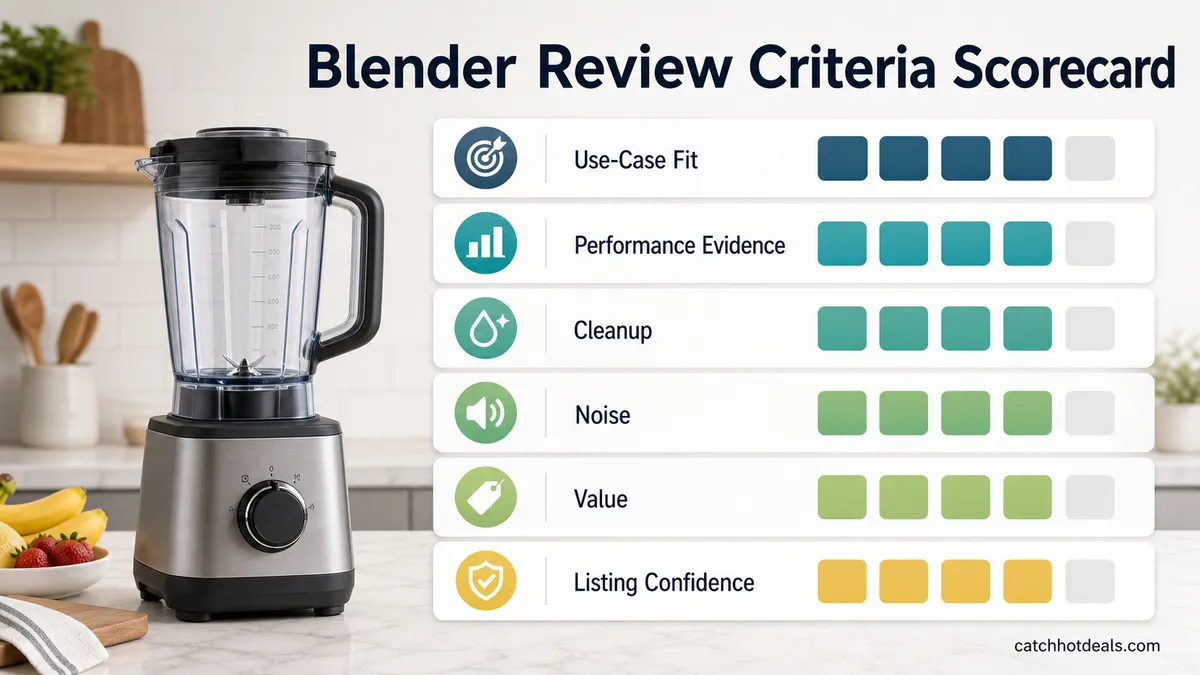
| Criterion | Suggested Weight | What It Means |
|---|---|---|
| Buyer/use-case fit | 25% | The blender matches the shopper’s main task: smoothies, ice, frozen fruit, nut butter, soup, family batches, or small kitchens. |
| Performance evidence | 20% | Claims are supported by first-party tests, specs, credible editorial evidence, owner feedback, or clearly labeled research. |
| Ownership friction | 15% | Cleanup, noise, size, controls, warranty, and day-to-day ease affect repeat use. |
| Value for money | 15% | The recommendation explains when a budget, mid-range, or premium blender is enough. |
| Durability/support | 10% | Warranty, replacement parts, jar/blade durability, and brand support affect long-term use. |
| Amazon listing confidence | 10% | The model, included accessories, seller/availability, and product URL are checked before publishing. |
| Freshness/trust | 5% | The page has a recent update path, disclosure, and correction route. |
The scorecard is a writing and comparison framework, not a fake lab result. If a page publishes a numeric score, the score needs a visible method and enough evidence for readers to understand it.
How Often Do We Update Blender Guides?
Blender guides should be updated when the recommendation, listing, evidence, or internal route changes. A page does not need a fake daily refresh, but it should not leave shoppers with stale model names, broken links, or unsupported claims.
Update triggers include:
- Product discontinued, replaced, or merged into a different listing.
- Amazon product page changed model, bundle, seller, availability, or included parts.
- A better internal comparison page or buying guide becomes available.
- A product claim needs stronger proof or softer wording.
- Reader feedback flags a broken link, wrong model, or unclear recommendation.
- SERP quality thresholds change and competitors show better evidence or clearer criteria.
Readers can use the contact page to report stale listings, factual errors, or broken links.
How Do Affiliate Links Affect Our Recommendations?
Affiliate links do not decide which blender belongs on a Catch Hot Deals recommendation page. Catch Hot Deals may earn a commission from qualifying Amazon purchases, but the recommendation should still be based on buyer fit, evidence level, listing confidence, and value.
Affiliate disclosure is part of the methodology because blender pages often send readers to Amazon. The disclosure should appear near buying guidance and in the site policy area, not only as a technical footer link. You can read the site policy on the affiliate disclosure page.
Which Blender Pages Use This Methodology?
This methodology supports the pages where Catch Hot Deals asks readers to trust a recommendation. It should be linked from major blender buying guides, comparison pages, use-case lists, and product reviews.
Start with these live routes:
- The best blenders guide uses this methodology to explain why picks should be matched to budget, use case, evidence, and Amazon listing confidence.
- The blender buying guide uses this methodology to turn criteria into a practical decision path.
- The best blender for smoothies guide should apply this method to smoothie texture, frozen fruit, protein shakes, jar type, and cleanup.
Future trust pages can expand the testing-criteria process and the Amazon recommendation process in more detail. Until those pages are live, this methodology page should carry the trust explanation.
FAQ
Does Catch Hot Deals test every blender hands-on?
No, Catch Hot Deals should only say a blender was tested when first-party testing proof is visible. When a recommendation is based on product specs, owner feedback, marketplace checks, or editorial research, the article should label it as reviewed, compared, researched, or listing-checked.
Can a researched blender recommendation still be useful?
Yes, a researched blender recommendation can be useful when it clearly explains its evidence level, buyer use case, specs, tradeoffs, and Amazon listing checks. The key is honest wording, not inflated testing language.
Why do Amazon blender links need to be checked again?
Amazon blender links need to be checked again because listings can change by model, seller, bundle, price, availability, and included accessories. A current listing check helps prevent a page from sending shoppers to the wrong product version.
Do affiliate commissions change the blender ranking?
No, affiliate commissions should not change the blender ranking. A blender should be recommended because it fits the buyer task, has enough supporting evidence, and passes listing checks.
How can readers report a problem with a recommendation?
Readers can report a stale listing, broken link, wrong model, or unclear claim through the contact page. A useful report should include the page URL, the product name, and what looked wrong.