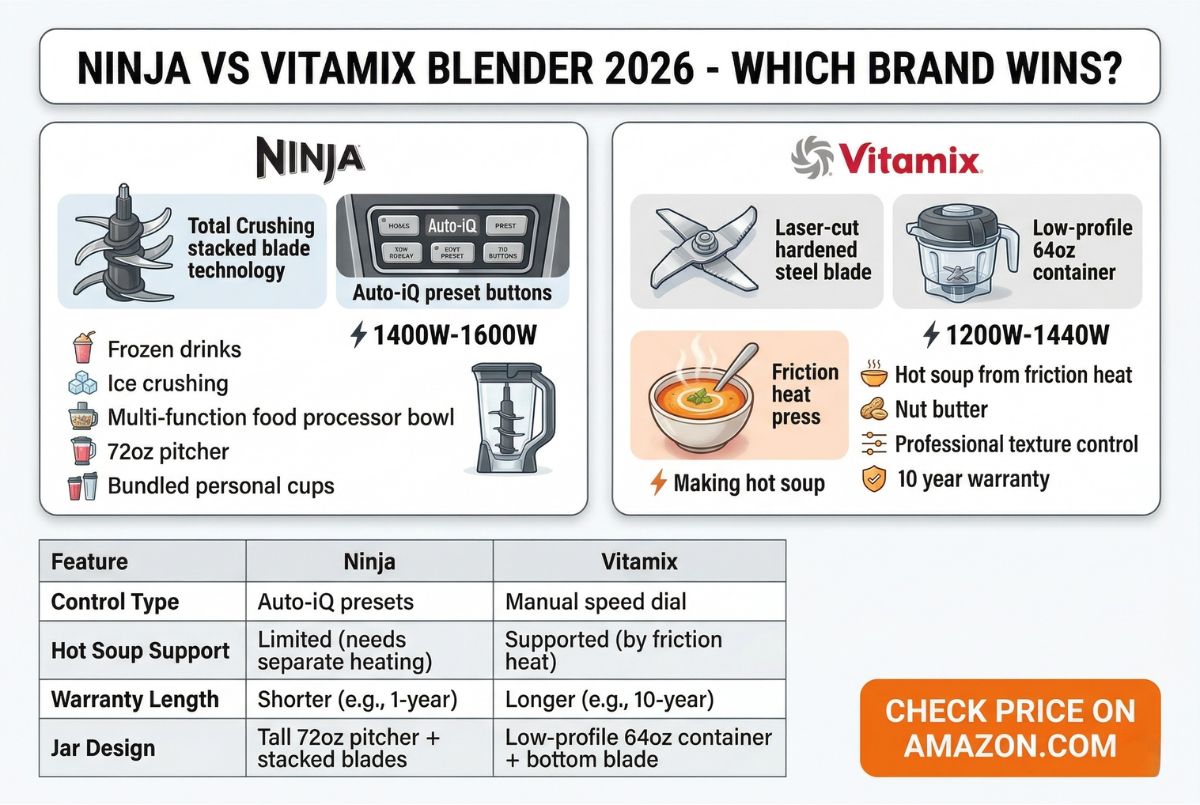
Ninja and Vitamix are the two most searched blender brands on Amazon, and the comparison is deceptively complex. Ninja targets the mid-range to premium consumer market with Auto-iQ preset programs and wattage up to 1600W on models like the SS151 TWISTi Blender DUO. Vitamix targets the professional and premium household segment with friction heat capability and wattage from 1200W to 1440W. This guide compares the Ninja BN701 Professional Plus at 1400W, the Ninja BL770 Kitchen System at 1500W, and the Ninja SS151 TWISTi at 1600W against the Vitamix 5200 at 1380W, the Vitamix Professional Series 750 at 1440W, and the Vitamix Explorian E310 at 1200W across motor power, program automation, jar design, price-to-performance, and long-term reliability.
What Are Ninja and Vitamix?
Ninja and Vitamix serve different market positions: Ninja delivers feature-rich countertop systems at mid-range prices with Auto-iQ automation, while Vitamix delivers professional-grade durability and friction heat capability at premium price points.
Ninja launched in 2009 as a disruptive countertop appliance brand, competing aggressively on motor wattage and bundled accessories. The brand’s defining technology is Auto-iQ — pre-programmed speed ramping sequences that automate blending for specific textures like smoothies, frozen drinks, and sauces. Ninja bundles multiple containers and accessories in most packages, which inflates the perceived value without raising the motor specification. The BL770 Kitchen System, for example, includes a food processor bowl and two personal cups alongside the main pitcher, making it a multi-function hub rather than a single-purpose blender.
Vitamix has been refining professional blending since 1921 and built its reputation on raw motor engineering and thermal capability. The defining Vitamix feature is friction heat — every Vitamix model above 1200W can generate enough blade-ingredient friction to steam hot soup directly in the jar without a stove. The low-profile 64oz container sits below most kitchen cabinet lines, and the 10-year residential warranty signals confidence in motor longevity that no competitor matches.
Ninja Brand Philosophy and Auto-iQ Technology
Ninja’s engineering philosophy prioritizes accessibility and feature breadth over single-purpose refinement. Auto-iQ technology removes the learning curve from blending by automating speed ramping through pre-set programs that run for a fixed duration and sequence. Users press one button and the blender handles texture progression from chunk to smooth. This approach works well for beginners and households with multiple users who prefer consistent results without manual speed dial adjustment. Ninja’s Total Crushing blade technology uses stacked blade geometry to break down frozen ingredients and fibrous vegetables more aggressively than single-level blade designs, which is particularly effective for ice crushing and leafy green smoothies.
Vitamix Brand Philosophy and Professional Engineering
Vitamix’s philosophy centers on single-purpose excellence. Every design decision serves one goal: consistent professional-quality blending results across hot soup, nut butter, frozen desserts, and fibrous ingredients. The 10-year residential warranty is the clearest expression of this confidence — Vitamix engineers its motors for sustained high-speed operation without thermal throttling, which means daily 10-minute hot soup sessions do not degrade performance over years of use. The variable speed dial gives users granular control over texture progression, which appeals to experienced users who want to replicate barista-quality results through manual technique.
Where the Two Brands Diverge Most
The fundamental divergence between Ninja and Vitamix is thermal capability and single-purpose focus. Vitamix at 1200W+ generates friction heat sufficient to steam hot soup from room-temperature ingredients in under 6 minutes — a capability no Ninja model replicates. Ninja instead focuses on frozen ingredient crushing and multi-function versatility, bundling food processor bowls and personal cups to justify mid-range pricing. For buyers who want hot soup, nut butter, and professional-grade texture control, Vitamix wins decisively. For buyers who prioritize frozen drinks, Auto-iQ convenience, and bundled accessories, Ninja wins on value.
Motor Power and Performance
Ninja leads on raw wattage at comparable price points, but Vitamix’s thermal engineering produces measurably different results on hot soup and nut butter. For daily smoothies and frozen drinks, both brands perform at parity — the choice comes down to whether you need friction heat capability.
The wattage comparison favors Ninja at equivalent price tiers. The Ninja SS151 TWISTi at 1600W, the BL770 Kitchen System at 1500W, and the BN701 Professional Plus at 1400W all outpace the Vitamix Explorian E310 at 1200W on raw motor specification. However, wattage does not tell the whole story — blade efficiency, jar geometry, and thermal management all influence real-world performance. The Vitamix 5200 at 1380W and the Professional Series 750 at 1440W both generate friction heat that Ninja models at higher wattage cannot match, because Vitamix’s blade assembly and container geometry are optimized for sustained high-speed thermal generation rather than burst ice crushing.
Wattage Range Comparison 1200W to 1600W
| Tier | Ninja | Vitamix |
|---|---|---|
| Entry | 900W – 1200W (BN301, BN401) | 1200W (E310 Explorian) |
| Mid | 1200W – 1500W (BN701, BL770) | 1380W (5200) |
| High | 1500W – 1600W (SS151 TWISTi) | 1440W (Professional Series 750) |
| Hot Soup Support | Not supported | Full friction heat at 1200W+ |
| Nut Butter Support | Partial — extended processing | Full — friction heat assists |
Frozen Ingredients and Hot Soup Capability
For frozen mango, ice cubes, and frozen berries, Ninja’s Total Crushing blade technology at 1400W to 1600W delivers faster breakdown than Vitamix at equivalent wattage. The stacked blade geometry creates more blade-ingredient contact per revolution, which matters for ice crushing and frozen fruit processing. However, Vitamix’s low-profile container and hardened steel blade assembly produce a smoother final texture on fibrous ingredients like kale and wheatgrass, because the wider blade-to-ingredient ratio creates a more even blend without over-processing.
On hot soup, Vitamix dominates entirely. The 1440W Professional Series 750 and the 1380W Vitamix 5200 both generate enough friction heat to bring vegetable soup to steaming temperature in under 6 minutes through blade-ingredient friction alone. Ninja does not market hot soup capability for any model, because the blade assembly geometry and container design do not produce the sustained thermal conditions required for friction heating.
Auto-iQ Programs vs Manual Speed Control
Ninja’s Auto-iQ is the clearest practical advantage for households with multiple users or inconsistent technique. The BN701’s three Auto-iQ presets (Smoothie, Frozen Drink, Spread) automate texture selection through pre-programmed speed ramping sequences that run without user supervision. Users add ingredients, press a button, and the blender handles the rest. Vitamix’s variable speed dial and pulse feature offer more control but require active attention to achieve consistent results — a trade-off that matters for beginners but benefits experienced users who want to control texture progression manually.
Best Picks from Each Brand
Best Ninja Blender for Most Buyers
The Ninja BN701 Professional Plus at 1400W is the best Ninja for most buyers. It delivers the highest Auto-iQ wattage in the Ninja countertop lineup at the mid-range price tier, with Total Crushing blade technology that handles frozen fruit, ice, and leafy greens without stalling. The three Auto-iQ presets automate texture control for smoothies, frozen drinks, and spreads, which removes the learning curve for households with multiple users. The 72oz Total Crushing pitcher handles family batches, and the dishwasher-safe blade assembly simplifies cleanup.
Best Vitamix Blender for Most Buyers
The Vitamix Explorian E310 at 1200W is the best Vitamix for buyers entering the professional blender category. It delivers the core Vitamix engineering advantages — friction heat for hot soup, 10-year warranty, self-cleaning function — at the lowest price tier in the Vitamix lineup. The 64oz low-profile container fits under standard kitchen cabinets, and the variable speed dial gives experienced users the texture control that Auto-iQ cannot replicate. For buyers who want professional-grade results on hot soup, nut butter, and fibrous ingredients without paying for premium-tier features, the E310 is the practical entry point.
Best for Budget-First Buyers
For buyers who want Auto-iQ automation at the lowest price tier, the Ninja BL770 Kitchen System at 1500W delivers the best feature-to-price ratio. The bundled food processor bowl and two personal cups expand functionality beyond pure blending, which justifies the price against single-function competitors. The 1500W motor handles frozen ingredients and fibrous vegetables without stalling, and the Auto-iQ presets reduce the technique requirement for consistent results. The trade-off is bulk — the multi-container system takes more cabinet space than a single-pitcher blender.
Which Brand Is Better?
Vitamix wins for buyers who prioritize hot soup, nut butter, professional-grade texture control, and long-term motor reliability. Ninja wins for buyers who prioritize Auto-iQ automation, frozen drink performance, bundled multi-function accessories, and lower entry prices. The choice between these brands is fundamentally a choice between professional single-purpose engineering and consumer-accessible multi-function versatility.
The Ninja vs Vitamix comparison is less about which brand is objectively better and more about which engineering philosophy fits your kitchen priorities. Vitamix builds the blender that lasts a decade and produces professional results on every texture. Ninja builds the blender that does more things at a lower price with less technique required.
Price-to-Performance Value
Vitamix at the entry tier (E310) delivers professional-grade thermal capability and a 10-year warranty at roughly twice the price of comparable Ninja models. The price premium is real, but the value case is also clear: a Vitamix that lasts 10 years under daily heavy use costs less per year than a Ninja that requires replacement every three to four years under equivalent use. Ninja at the mid-range tier (BN701, BL770) delivers more wattage, Auto-iQ automation, and bundled accessories at a lower price, which wins on feature value for buyers who do not need friction heat capability.
Warranty and Long-Term Reliability
Vitamix’s 10-year full residential warranty is the strongest in the blender industry. Ninja’s warranties range from 1 year (base models) to 5 years (premium models like the BN701). The warranty gap reflects different engineering confidence levels — Vitamix builds motors for sustained high-speed thermal operation, while Ninja optimizes for burst performance and feature breadth within a shorter expected product lifecycle. For buyers who plan to use their blender daily for five or more years, the Vitamix warranty advantage is significant.
Motor Longevity in Daily Use
Vitamix motors are engineered to run continuously at high speed without thermal throttling, which means daily 10-minute hot soup sessions and weekly nut butter batches do not degrade performance over years. Ninja motors at 1400W to 1600W are engineered for burst performance on frozen ingredients and thick mixtures, which creates more thermal stress during extended processing sessions. For daily smoothie use (3 to 5 minutes per session), both brands last equally well. For daily hot soup preparation and weekly nut butter batches, Vitamix’s thermal engineering provides a meaningful longevity advantage.
Frequently Asked Questions
Is Ninja more powerful than Vitamix?
Ninja models at equivalent price tiers typically offer higher peak wattage than Vitamix — the Ninja SS151 TWISTi at 1600W outpaces the Vitamix E310 at 1200W on raw motor specification. However, wattage alone does not determine blending performance. Vitamix’s blade assembly geometry, container design, and thermal engineering produce better results on hot soup and fibrous ingredients at lower wattage, while Ninja’s stacked Total Crushing blades produce faster ice breakdown at higher wattage. See our best high performance blender guide for full wattage comparisons.
Which brand lasts longer?
Vitamix typically lasts longer under daily heavy use due to thermal engineering and a 10-year warranty versus Ninja’s 1 to 5-year warranties. Vitamix motors are designed for sustained high-speed operation without thermal throttling, while Ninja motors are optimized for burst performance. For daily smoothies and frozen drinks, both brands last well within their warranty periods. For daily hot soup and weekly nut butter, Vitamix’s motor longevity advantage is significant.
Can Ninja and Vitamix make hot soup?
Only Vitamix at 1200W+ generates sufficient friction heat to make hot soup directly in the jar. Ninja does not market hot soup capability for any current model, because the blade assembly geometry and container design do not produce the sustained thermal conditions required for friction heating. The Vitamix Professional Series 750 at 1440W and the Vitamix 5200 at 1380W can bring vegetable soup to steaming temperature in under 6 minutes through blade-ingredient friction alone.
What is Auto-iQ and why does it matter?
Auto-iQ is Ninja’s pre-programmed blending technology that automates speed ramping for specific texture outcomes. Users select a preset (Smoothie, Frozen Drink, Spread), press start, and the blender executes a pre-timed speed sequence without user intervention. Auto-iQ removes the technique requirement for consistent results, which makes Ninja more accessible for beginners and households with multiple users who prefer hands-off operation. Vitamix does not offer equivalent pre-programmed automation on most models — texture control on Vitamix requires manual speed dial adjustment.
Which is easier to use for beginners?
Ninja is easier for beginners due to Auto-iQ presets that automate texture selection. First-time blender users can achieve consistent results by pressing one button, without learning speed dial technique. Vitamix offers more control but requires more attention to replicate consistent results — the learning curve is real for users who have never used a variable speed blender. For households with beginners or users who prefer button-push convenience, Ninja wins on usability.
Do Ninja blenders need more maintenance than Vitamix?
Ninja blenders require more frequent blade and seal replacement under heavy use, particularly on models with Total Crushing blade stacks that process frozen ingredients aggressively. Vitamix’s simpler blade assembly and higher-quality drive components reduce maintenance frequency. Both brands benefit from regular cleaning — the self-cleaning function on both Ninja and Vitamix handles most residue with warm water and dish soap in under 60 seconds.
Verdict
Choose Vitamix if you want hot soup, nut butter, professional texture control, and a blender that lasts a decade with a 10-year warranty. Choose Ninja if you prioritize Auto-iQ automation, frozen drink performance, bundled multi-function accessories, and a lower entry price. For most households, the decision comes down to whether you need friction heat capability — if yes, Vitamix is the clear choice; if no, Ninja delivers more features per dollar.
The Ninja vs Vitamix comparison rewards honest self-assessment of your actual blending habits. If you make hot soup weekly, nut butter monthly, and want results that match a professional juice bar, Vitamix pays for itself over a decade of daily use. If you make frozen smoothies daily, prefer button-push convenience, and want Auto-iQ texture automation, Ninja delivers more value at the mid-range price tier. See our best blenders 2026 roundup for full rankings, and check the blender motor power guide for wattage tier details.
See best high performance blender guide
See best blenders 2026 roundup
This article contains Amazon affiliate links. We may earn a commission when you purchase through links on this page, at no extra cost to you. See our affiliate disclosure for more information.