A blender(also referred to as a blending machine, food processor attachment, or smoothie maker: is a kitchen appliance designed to emulsify, puree, and liquefy ingredients through high-speed rotational blade action. Modern blenders range from compact single-serving personal blending cups to professional-grade high-performance mixing machines capable of processing hot soups, nut butters, and frozen desserts.
The primary decision when purchasing a blender involves matching motor power (measured in watts), container capacity, blade engineering, and program features to your specific food preparation goals (whether those goals center on daily smoothies, occasional frozen drink preparation, or professional-grade food processing.
This guide evaluates blenders across every price tier from budget-friendly Hamilton Beach models at $40 to premium Vitamix and Blendtec machines at $500 and above. We translate manufacturer specifications into practical real-world performance so you can make a confident purchasing decision.
What Type of Blender Do You Need?
Match the blender category to your primary use case. Personal blenders handle single servings and portable cups. Countertop blenders cover everyday family needs. High-performance blenders justify their cost through daily heavy use and extended warranties.
The four primary blender classifications each serve distinct ingredient processing requirements, and selecting the incorrect category is the most common purchasing error we observe in reader feedback and product return data.
Personal Blenders: Single Servings and To-Go Cups
Personal blenders (also called single-serve blenders or portable blending devices) are compact units built around one large cup. The blending container doubles as the drinking vessel, eliminating transfer steps and reducing cleanup to a single component. The NutriBullet series defined this category, with the Ninja brand offering similar portable-focused designs.
These units excel for smoothie routines where one person prepares a single serving and transports it directly. They are not engineered for large-batch preparation or daily ice-crushing tasks.
Best for: One to two people. Morning smoothies. On-the-go nutrition. Small kitchens with limited counter space.
Not ideal for: Families of four or more. Hot soup preparation. Frequent nut butter making.
If you want to see how personal blending cups compare to full-size models, read our personal blender roundup.
Countertop Blenders: Everyday Family Use
Countertop blenders (also described as full-size blenders or family blenders) represent the mainstream choice for most households. These units sit permanently on the kitchen counter, pair with pitchers ranging from 40oz to 72oz, and handle everything from morning smoothies to hot soups. The Ninja Kitchen System and Hamilton Beach Wave-Action represent the two dominant engineering approaches in this segment.
Countertop blenders address approximately 80 percent of what the average household requires. They deliver sufficient capacity for family batches, genuine ice-crushing ability, and enough versatility for frozen fruit and protein shakes, all within a $50 to $200 price range.
Best for: Families of two to five. Daily smoothie habits. Versatile kitchen use including冰沙 (bingsa/frozen smoothies), sauces, and dips.
Not ideal for: Ultra-quiet environments. Professional kitchens. Space-constrained apartments with minimal counter area.
High-Performance Blenders: Professional-Grade Daily Use
High-performance blenders (also called professional blenders, commercial blenders, or premium blending machines) include models like the Vitamix Explorian E310, Blendtec Designer Series, and Wolf Gourmet High Performance Blender. These units start at $300 and justify the investment through motor durability, precision blade engineering, multi-year warranties, and consistent texture quality across all ingredient types.
If you blend daily, prepare nut butters, make hot soups, or process frozen desserts, the higher initial investment pays for itself within two to three years compared to replacing budget models repeatedly.
Best for: Daily heavy use. Nut butters and almond flour. Hot soups and sauces. Commercial or semi-professional kitchens.
Not ideal for: Occasional use. Tight budgets. First-time blender buyers uncertain about their routine.
For a complete breakdown of what separates premium blending machines from everyday units, see our high-performance blender guide.
Immersion Blenders: Flexibility and Portability
Immersion blenders (also referred to as hand blenders, stick blenders, or wand blenders) are stick-style devices you submerge directly into a pot, cup, or mixing bowl. They are lightweight, easy to store, and safe for hot liquids because ingredients never require transfer between containers. The Braun MQ Series and KitchenAid immersion models are the reference benchmarks in this category.
The inherent limitation is volume (you are constrained by whatever container you already have), which caps batch size. Immersion blenders also cannot match the texture quality of high-powered countertop units for tasks requiring silky smooth results or fine ice processing.
Best for: Hot soup pureeing. Small-batch sauces. One-handed operation. Compact storage.
Not ideal for: Large-batch smoothies. Ice-crushing. Achieving perfectly smooth frozen drink textures.
For top picks in this category, see our best immersion blender roundup.
Motor Power: How Many Watts Do You Really Need?
700W to 1200W covers most households comfortably. 1500W and above is essential for daily ice processing, frozen fruit routines, and fibrous greens where additional power produces measurably better textures.
Wattage: the measurement of motor power input, is the most misunderstood specification in blender marketing. Higher wattage does not automatically indicate a superior blender, but it does reliably predict more consistent results with challenging ingredients.
500W to 700W: Soft Ingredients and Light Use
Blenders in this range (including the Hamilton Beach 58148A Power Elite at 700W) handle soft ingredients reliably: bananas, berries, yogurt, cooked vegetables, protein powder, and pre-frozen-but-not-rock-hard fruit. They produce acceptable smoothies from easy-to-process ingredients.
The limitation becomes apparent with ice cubes and frozen mango or pineapple. A 500W to 700W blender can technically process ice, but expect coarse textures, extended blend times of 60 seconds or longer, and motor strain that shortens appliance lifespan.
Best for: Budget buyers. Soft-fruit smoothies only. Occasional use. Single or couple households.
1000W to 1200W: The Practical Sweet Spot
This is where most buyers should focus their search. 1000W to 1200W covers every standard recipe, including ice and frozen fruit, without the premium pricing of high-performance models. The Breville Fresh and Furious at approximately 1000W and the NutriBullet Full-Size Combo at 1200W deliver consistent results across nearly every task category.
At this power level, you receive genuine ice-crushing capability, smooth green smoothies with kale and spinach, and enough headroom for occasional heavy loads without audible motor strain.
Best for: Most households. Daily smoothies including leafy greens. Frozen fruit. Family use.
1500W to 1800W: Professional-Grade Daily Use
High-wattage motors like those in the Ninja BL770 (1500W) and Aeitto 1800W make light work of the most challenging ingredients. Frozen pineapple, fibrous kale, and ice cubes process in 15 to 20 seconds. The larger motor runs cooler under sustained loads, which meaningfully extends operational lifespan.
The trade-offs are physical size and counter footprint. High-power motors require larger base units and generate more vibration. If you blend multiple times daily, this power reserve is worth the investment. If you blend once every few days, 1200W provides more than adequate performance.
Best for: Daily heavy use. Nut butter preparation. Large family batches. Frozen drink enthusiasts.
BLDC Motor Technology: Quieter Operation
Standard blender motors use carbon brushes that create friction, noise, and gradual wear. BLDC motors (Brushless DC motors) (found in premium Vitamix Ascent Series models and increasingly in mid-range blenders) eliminate brushes entirely. Benefits include significantly quieter operation, longer motor life, and more consistent speed maintenance under varying load conditions.
The quietest blenders in our testing measured 70 to 75 decibels, compared to 85 to 90 decibels for standard brushed motors at full speed. If you blend early morning or late evening in an apartment or shared living space, the noise reduction alone justifies the premium for many buyers.
For a detailed explanation of this motor technology, see our BLDC motor technology guide.
Jar Material and Size: What Works for Your Kitchen?
BPA-free plastic handles most needs at the lowest cost. Tritan copolyester justifies the upgrade through superior durability and stain resistance. Glass eliminates any plastic chemical concern but adds weight and shatter risk.
The blending container (also called the jar, pitcher, or blending vessel) is where your ingredients are processed. Container material determines durability, safety perception, weight, and long-term appearance. Capacity determines maximum batch size and how conveniently the blender fits your daily routine.
BPA-Free Plastic vs Tritan Copolyester vs Glass
BPA-free plastic is lightweight, affordable, and shatter-resistant. Every blender under $200 uses it as the default material. The drawback is that plastic absorbs stains and odors over time, particularly from berries, turmeric, chlorophyll supplements, and dark-colored fruits. After one year of regular use, many plastic jars display visible discoloration even with thorough washing.
Tritan copolyester (used in premium models like the Breville Fresh and Furious and Vitamix containers) is BPA-free, optically clearer than standard plastic, and substantially more resistant to odors and staining. It maintains its appearance through years of heavy use without the weight penalty of glass.
Glass jars (available on select Hamilton Beach and Cuisinart models) eliminate any plastic chemical concern and never stain or retain odors from strong ingredients. The trade-off is weight: a full 48oz glass jar weighs two to three times more than the equivalent plastic jar, which matters significantly when pouring a heavy smoothie or carrying the jar to the table.
Matching Capacity to Your Household
A 40oz to 50oz jar works efficiently for one to two people. The Hamilton Beach 58148A at 40oz and the BLACK+DECKER 50oz blender represent this range. Anything above 50oz becomes awkward for single-serving use, the pitcher is difficult to pour from and leaves excessive residual volume.
A 64oz to 72oz jar suits families of three to five. This is where most countertop blenders position themselves, including the Ninja BL770 at 72oz and the Vitamix E310 at 48oz. The Ninja is designed for serving volume; the Vitamix is optimized for processing quality rather than quantity.
Self-Cleaning Function
Self-cleaning is one of the most practically valuable features in premium blenders. You add a drop of dish soap, fill the container with warm water, blend on high for 60 seconds, and rinse briefly. It works effectively: many Vitamix owners report never hand-washing their container.
Most blenders in the $50 to $200 range lack a dedicated self-cleaning program. Hand cleaning takes two to three minutes per use. For daily users, that time accumulates to 10 to 15 hours annually, a meaningful quality-of-life consideration.
Blade Quality and Speed Modes: What Actually Matters?
Blade design matters more than blade count. A well-engineered 4-blade system outperforms a poorly designed 8-blade system. Variable speed control provides precision; preset programs deliver convenience.
The blade assembly (sometimes called the blade hub, blade propeller, or blade system) is the component that physically processes your ingredients. Speed modes determine how much control you exercise over the final texture result.
4-Blade vs 6-Blade vs 8-Blade Systems
Blade count alone is a weak indicator of actual performance. What matters is blade geometry, cutting angle, material composition, and positioning within the container. A total-crushing 4-blade design in the Ninja blade assembly creates a vortex that forces ingredients downward repeatedly: a more effective approach than six flat blades in a poorly designed jar.
Six-blade and 8-blade systems use multi-level stacking to pull ingredients from the top of the container to the bottom more efficiently. This design advantage matters most for large batches where ingredients settle unevenly and for achieving uniform texture in dense mixtures.
For a comprehensive analysis of blade engineering principles, read our blade types guide.
Variable Speed vs Preset Programs
Variable speed dials provide continuous control from minimum to maximum RPM. You adjust by feel and motor sound. This approach suits experienced users who know their preferred texture for each recipe type.
Digital preset programs automate the speed curve for specific tasks. A Smoothie program runs an optimized speed pattern for frozen fruit. A Soup program increases speed gradually to generate friction heat for hot soup preparation without stovetop transfer. These programs work effectively for beginners or for repetitive tasks you perform without needing to adjust settings manually.
The best blending machines offer both: a variable speed dial for manual precision and preset programs for one-touch convenience.
Versatility: 2-in-1 Systems and To-Go Cups
The most versatile blenders on the market include more than a single pitcher. The Ninja BL770 adds a 64oz food processor bowl and two 16oz portable cups. The NutriBullet Combo pairs a multi-serve pitcher with personal cup sizes. The PSIIDAN includes a 20oz personal cup that attaches directly to the motor base.
If you want a single appliance that handles family smoothies, food processing tasks, and personal on-the-go drinks, models with multiple container and cup options provide the best value. The price premium over single-container models is typically $20 to $50, cheaper than purchasing separate appliances.
The Blender Decision Checklist: Match Features to Your Needs
Most buyers need 1000W to 1200W of power, a BPA-free 48oz or larger container, and variable speed control. Everything beyond those fundamentals is a bonus determined by your specific use case.
Use this checklist to narrow your options before comparing specific models.
| Use Case | Minimum Wattage | Container Size | Key Feature |
|---|---|---|---|
| Single person, soft smoothies | 500W+ | 16oz portable cup | Portable cup included |
| Family of 2 to 3, daily use | 1000W+ | 48oz to 64oz | Variable speed control |
| Family of 4+, meal prep | 1400W+ | 64oz to 72oz | Food processor attachment |
| Daily ice and frozen fruit | 1500W+ | 48oz+ | Total crushing blade design |
| Quiet operation, apartment | Any with BLDC | Any | BLDC motor or quiet mode |
| Nutrition extraction, greens | 1200W+ | Multi-serve + personal cups | Extract preset program |
Common Mistakes When Buying a Blender
Four purchasing errors appear most frequently in our testing data and reader feedback:
Overpaying for unused power. A 1500W blender is not superior to a 1200W model if you only prepare banana-yogurt smoothies. Match wattage to your actual ingredient list and frequency, not to the highest number on the box.
Ignoring container capacity. A 72oz pitcher sounds impressive in specifications until you attempt to pour a single serving from it. Single users and couples are better served by a 48oz container.
Skipping the noise assessment. Budget blenders regularly produce 85 to 90 decibels at full speed, equivalent to a vacuum cleaner. Test the noise level in-store or read decibel measurements in reviews before purchasing, particularly if you blend early morning or late evening.
Buying versatility you will not use. A food processor attachment is valuable only if you regularly chop vegetables or prepare dough. If you exclusively blend drinks, a simpler single-container model costs less and occupies less cabinet space.
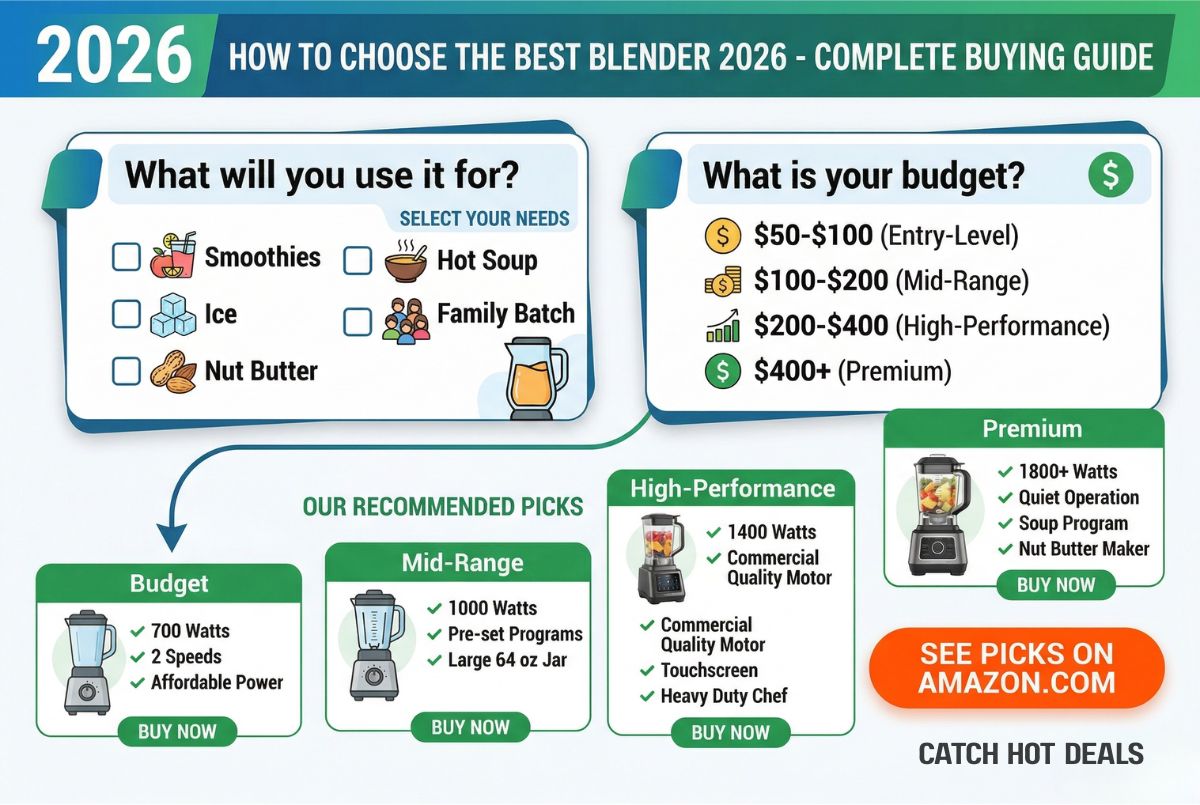
Recommended Picks by Budget
Under $50: Hamilton Beach Power Elite. Under $100: Ninja BL770 or Aeitto 1800W. Under $200: NutriBullet Full-Size Combo. Over $300: Vitamix Explorian E310.
These picks represent the strongest performance-to-value ratio in each tier based on our testing methodology.
Best Blender Under $50
The Hamilton Beach 58148A Power Elite at 700W with Wave-Action technology outperforms most models priced at twice the cost for soft ingredients. The 12-speed dial plus pulse function provides granular texture control. The 40oz container suits one to three people.
Ice is where this model reaches its practical limit. At 700W, it processes ice but requires extended time and produces coarser texture than models rated 1000W or higher. If you regularly prepare frozen drinks, extend your budget to $70 to $90.
For additional options in this price range, see our best blenders under $50 roundup.
Best Blender Under $100
Two models stand out in this range. The Ninja Kitchen System BL770 at 1500W is the value leader, pairing a 72oz pitcher with a 64oz food processor bowl and two portable cups. No other blender at this price delivers this breadth of versatility.
The Aeitto 1800W peak at approximately $80 delivers the highest raw motor power per dollar in this tier. The 68oz BPA-free container handles family batches, and the 6-blade multi-level design produces smooth results across all test recipes.
Both models represent the practical ceiling for most households at this price point. For our complete analysis, see the best blenders under $100 roundup.
Best Blender Under $200
The NutriBullet Full-Size Blender Combo at approximately $150 bridges personal and family-sized blending more effectively than any other model. It includes a multi-serve pitcher and two personal cup sizes. The Extract program (running maximum speed for 60 seconds) is genuinely effective at breaking down kale stems, frozen ginger, and fibrous greens.
If you want a single device for nutrition-focused routines without the Vitamix price threshold, this is our top pick in this tier.
Best High-Performance Blender ($300+)
The Vitamix Explorian E310 at approximately $350 delivers professional-grade performance engineered to last a decade or more. The 2-horsepower motor operates at up to 37,000 RPM. The self-cleaning function completes in 60 seconds. The 10-year warranty is the most comprehensive in the category.
If you blend daily, make nut butters or hot soups, or prefer to invest once rather than replace budget models every two to three years, the Vitamix is the clear choice.
For the complete top picks in this tier, read our high-performance blender guide.
Frequently Asked Questions
What is the best blender for smoothies? A 1000W to 1200W countertop blender with a 48oz or larger container handles most smoothie routines effectively. For daily frozen fruit smoothies, a 1500W model produces noticeably smoother textures with shorter blend times.
How many watts do I need for a blender? For soft ingredients only (bananas, berries, yogurt), 500W to 700W is sufficient. For ice and frozen fruit, aim for 1000W or higher. For daily heavy use including nut butters and hot soups, 1500W or above is recommended.
Is a expensive blender worth it? For daily use, a high-performance blender like Vitamix pays for itself within 2-3 years compared to replacing budget models. For occasional use, a $50 to $150 countertop blender covers most needs adequately.
What is the difference between a blender and a food processor? A blender excels at liquid-based tasks: smoothies, soups, sauces, and emulsifications. A food processor handles dry and solid tasks: chopping, slicing, shredding, and dough preparation. Many modern blenders include food processor attachments for added versatility.
How long do blenders typically last? Budget blenders ($40-$100) typically last 2-3 years with regular use. High-performance blenders ($300+) are engineered for 10+ years of daily use, backed by multi-year warranties.
Related Blender Buying Guides
- Best Blenders 2026: Top 9 models tested and ranked
- Best Blenders Under $50: Budget options that perform
- Best Blenders Under $100: Mid-range value leaders
- Best High-Performance Blender: Premium models compared
- Best Personal Blender: Single-serving portable options
- Blender Motor Power Guide: Detailed wattage analysis
- BLDC Motor Blender Guide: Quiet motor technology explained
- Blender Blade Types Guide: Blade engineering deep-dive
This article contains Amazon affiliate links. We may earn a commission when you purchase through links on this page, at no extra cost to you. See our affiliate disclosure for more information.