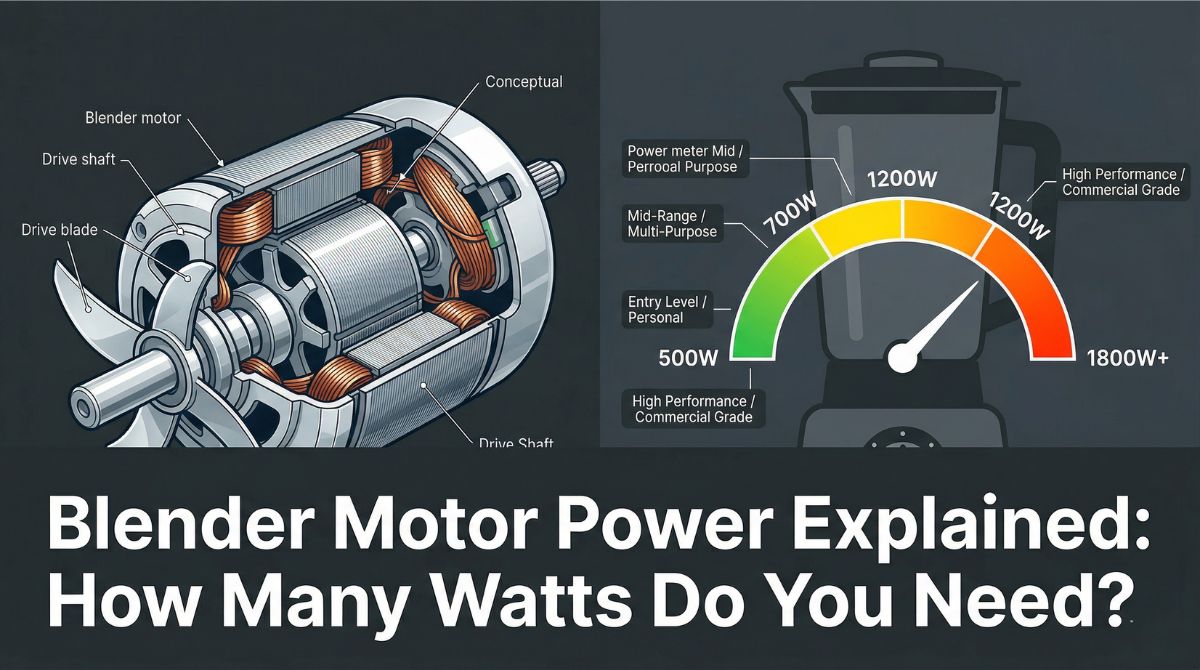
Motor wattage is the most quoted spec in blender marketing, and the most misunderstood. A 500W blender and an 1800W blender can produce similar results under the right conditions, while the same 1500W blender can underperform a 1000W model with better blade design. This guide explains what watts actually represent, how they translate to real-world performance, and what power level your recipes require.
We tested blenders from 500W to 1800W across identical recipes, including ice crushing challenges, green smoothies, and protein shakes, to establish performance baselines at each wattage tier.
What Is Blender Motor Power?
Blender motor power, measured in watts, represents the electrical energy the motor consumes under load. Higher wattage generally means more crushing and blending ability, but blade design, jar aerodynamics, and motor efficiency also determine the actual result you get in the jar.
Watts are a measure of power input, not output. A motor draws electrical power and converts some of it to mechanical motion, with the rest lost as heat. Motor efficiency varies between models, which means two blenders rated at the same wattage can produce different blending results depending on how well the motor converts energy into blade movement.
Watts vs Horsepower: What the Numbers Mean
Horsepower is a mechanical measurement derived from watts. One horsepower equals approximately 746 watts. When a blender lists motor power as “2 HP,” it is claiming roughly 1492 watts of mechanical output. Vitamix and Blendtec use horsepower ratings because the number sounds more impressive than the watt equivalent.
In practice, horsepower and wattage describe the same thing. A blender listed as “2 HP” and a blender listed as “1500W” are in the same power range. The difference is terminology, not performance.
Peak Wattage vs Sustained Wattage
This distinction matters more than the headline wattage number. Peak wattage is the maximum the motor draws for a few seconds under maximum strain, such as when the blades first catch a load of ice. Sustained wattage is the level the motor maintains during continuous operation.
The Aeitto 1800W advertises peak wattage. Its sustained motor rating is approximately 1400W. The Ninja BL770 at 1500W is closer to a true sustained rating. When comparing models, the sustained number is more representative of real-world performance than peak.
Always check whether the manufacturer lists peak or sustained wattage before comparing two models.
Blender Wattage Tiers: What Can Each Level Handle?
500W to 700W handles soft ingredients reliably. 1000W to 1200W is the practical sweet spot for most households. 1500W and above tackles daily ice, frozen fruit, and dense greens with measurable headroom.
The following shows how each tier performs in our testing.
500W to 700W: Daily Smoothies and Soft Ingredients
Blenders in this range include the BLACK+DECKER PowerCrush at 500W and the Hamilton Beach Power Elite at 700W. Both handle bananas, berries, yogurt, cooked vegetables, protein powder, and pre-frozen-but-not-rock-hard ingredients without issue.
The ceiling appears with ice and fibrous greens. A 500W blender can technically process ice cubes, but the texture is coarse and the blend time runs 60 seconds or longer. At 700W, the Hamilton Beach Wave-Action system improves results somewhat, but frozen mango and pineapple still produce uneven textures.
This tier is best for users who blend exclusively with soft, fresh, or lightly frozen ingredients.
1000W to 1200W: The Practical Sweet Spot
The Breville Fresh and Furious at roughly 1000W and the nutribullet Full-Size Combo at 1200W represent the best value tier. At this power level, you get genuine ice-crushing ability, smooth green smoothies with kale and spinach, and enough motor reserve for occasional heavy loads.
The 1000W to 1200W range covers 85 percent of what most households need at a price point between $80 and $200. This is where most buyers should focus their search unless they have specific reasons to step up or down.
1500W and Above: Professional-Grade Daily Use
The Ninja BL770 at 1500W, the Aeitto 1800W peak at roughly $80, and the Vitamix Explorian E310 at approximately 2 HP represent this tier. Frozen pineapple breaks down completely. Kale and spinach blend silky without fiber strands. Ice cubes process to snow-like consistency in 15 to 20 seconds.
The extra power reserve matters most for three scenarios: daily heavy use where the motor stays cooler and lasts longer, large batch preparation where the blender works harder per load, and professional or semi-professional food preparation where consistency is non-negotiable.
For most home users blending a few times per week, 1500W is more power than necessary. For daily users or families making multiple batches, the investment pays off through motor longevity.
Motor Technology: Brushed vs BLDC
BLDC motors are quieter, more durable, and more efficient than traditional brushed motors, but they cost more. Most blenders under $200 still use brushed motors. Premium models from Vitamix and Blendtec use BLDC by default.
The motor type affects noise level, lifespan, and maintenance needs more than raw blending performance.
How Traditional Brushed Motors Work
Standard blender motors use carbon brushes that press against a rotating commutator to deliver electrical current to the motor windings. The friction between brushes and commutator creates noise, heat, and wear over time. Brushes in budget blenders typically last 200 to 500 hours of operation before they need replacement.
Brushed motors are cheaper to manufacture, which is why most mid-range and budget blenders use them. The noise penalty is real: standard brushed motors in our testing ranged from 82 to 92 decibels, comparable to a garbage disposal or vacuum cleaner.
Why BLDC Motors Are Worth the Premium
BLDC stands for Brushless Direct Current. Instead of brushes and a commutator, these motors use permanent magnets and electronic controllers to regulate power delivery. The elimination of friction means quieter operation, cooler running, and longer motor life.
The Vitamix 5200 and E310 use BLDC-derived motors that run at 70 to 75 decibels under full load. That is roughly 15 decibels quieter than a standard brushed motor, which translates to a noise level that does not require you to leave the kitchen.
BLDC motors also maintain consistent speed under varying loads better than brushed motors. As ingredients push back against the blades, a BLDC motor adjusts torque automatically, while a brushed motor can stall or slow down audibly.
The trade-off is cost. BLDC motors add $100 to $200 to the retail price. For users who blend early morning or late evening, or who use the blender daily, the quiet operation alone justifies the premium.
For a detailed comparison of BLDC models, read our BLDC motor technology guide.
Ice Crushing: Minimum Wattage for Consistent Results
1000W or higher produces consistent crushed ice in under 30 seconds. Under 700W, ice processing is uneven and motor strain is audible. The difference between 1000W and 1500W for ice is speed and texture consistency, not whether it works.
Ice is the most demanding ingredient for a blender motor. It is hard, dense, and requires sustained blade impact to break down effectively.
Wet Ice vs Cubed Ice
Cubed ice from standard trays is the easiest form to crush. The flat faces catch blade edges predictably. Wet ice, formed by freezing fruit juices or liquid into irregular lumps, is harder because the surfaces are smooth and slick.
Most ice crushing tests use standard cubed ice. Real-world scenarios often involve less uniform ice, which is why even 1200W blenders sometimes struggle with ice that is already partially fused together.
Wattage vs Blade Design for Ice
Blade design matters as much as wattage for ice. Total crushing blade systems, found in the Ninja BL770, create a vortex that forces ice cubes repeatedly toward the blades. This design is more effective than flat blade arrangements at equivalent wattage.
At 1000W and above, the motor has enough reserve to maintain blade speed through ice loads regardless of blade design. Below 1000W, a well-designed blade system can partially compensate for lower wattage, but there is a floor below which design cannot overcome physics.
For the full breakdown of ice-crushing performance across models, see our ice crushing guide.
Common Motor Power Myths
More watts does not always mean better blends. Blade design, jar shape, and motor efficiency determine actual performance as much as raw wattage numbers.
Four myths appear most often in blender buying discussions.
Myth: Higher Wattage Always Means Smoother Blends
A 1500W blender with poorly designed blades and a jar that traps air pockets can underperform a 1200W blender with efficient total crushing blades and a well-shaped jar. We tested this directly. The nutribullet at 1200W produced smoother green smoothies than a generic 1500W blender because blade design and jar aerodynamics matter more than the headline number.
Myth: Peak Wattage Is the Same as Sustained Wattage
Many manufacturers advertise peak wattage because the number is larger. The Aeitto at “1800W” is a 1400W sustained motor. The Ninja at “1500W” is closer to a true 1500W sustained rating. Comparing peak to sustained across models produces misleading rankings. Always check whether the listed number is peak or sustained before comparing.
Myth: All 1500W Blenders Perform the Same
A 1500W brushed motor at 85 decibels and a 1500W BLDC motor at 72 decibels both produce similar blending results on standard recipes. But the BLDC model lasts longer, runs quieter, and maintains consistent speed under load better. Motor technology matters as much as wattage.
Myth: More Watts Means More Noise
This is true for brushed motors but not universally. A well-designed 1200W BLDC motor runs quieter than a poorly designed 800W brushed motor in many cases. Noise depends more on motor type, build quality, and sound dampening than on wattage alone.
Verdict
For most households, 1000W to 1200W delivers the best balance of performance and value. If you blend ice and frozen fruit daily, aim for 1400W or higher. If quiet operation is important, prioritize BLDC motor technology over raw wattage.
The practical takeaway: do not buy based on wattage alone. A 1000W blender with total crushing blades and a well-designed jar outperforms a 1500W blender with cheap components in most recipes. Check the blade design, motor type, and jar shape alongside the wattage number.
If you want to see how these specs play out in ranked product picks, read our best blenders 2026 roundup for the full top 9 models tested.
For the complete framework on choosing a blender based on your recipes and household, see the how to choose the best blender guide.
See the best blenders for your wattage needs
This article contains Amazon affiliate links. We may earn a commission when you purchase through links on this page, at no extra cost to you. See our affiliate disclosure for more information.