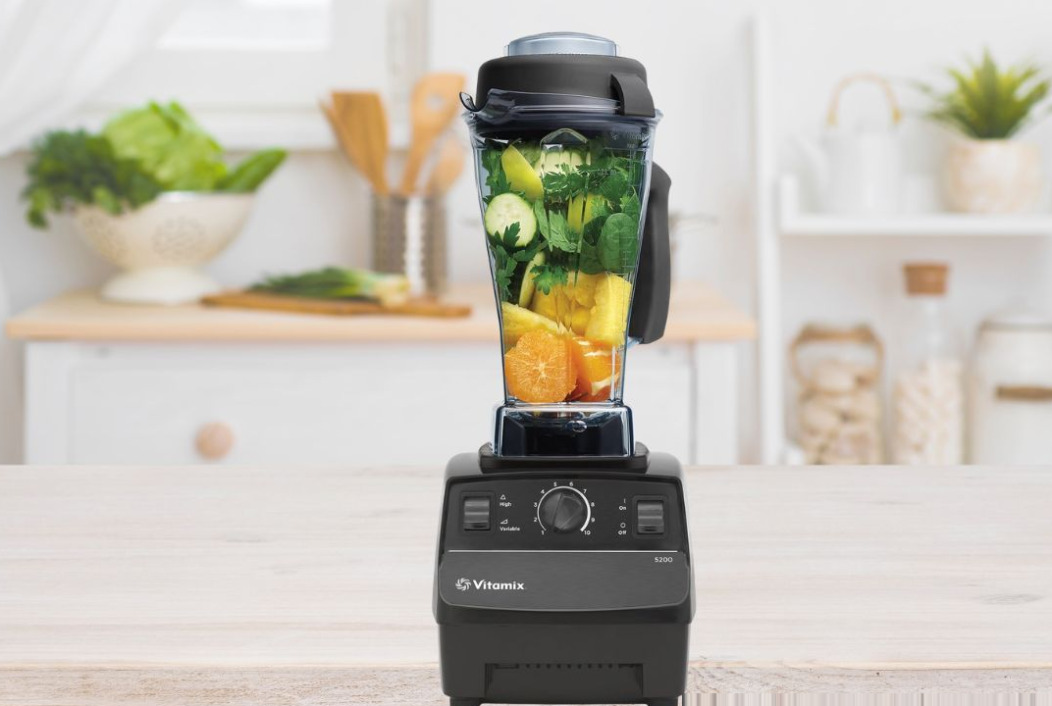
What Is the Vitamix 5200?
The Vitamix 5200 is a 1380W professional-grade countertop blender with a variable speed dial, high-performance blade assembly, and self-cleaning function. It is the blender that professional chefs and home enthusiasts have relied on since the early 2010s for tasks that require consistent texture control: hot soup, nut butter, frozen desserts, and fiber-rich green smoothies.
The 5200’s defining characteristic is the variable speed dial that gives users direct control over blade RPM from 240 to 12,000. Unlike Auto-iQ preset programs that automate texture decisions, the 5200 requires the user to develop technique. The learning curve is real: a new 5200 user produces worse results than an experienced user with the same machine. But the control is also the 5200’s greatest strength. Baristas and serious home cooks who master the variable speed dial produce textures that no preset program can replicate.
Specifications and Classic Design
The Vitamix 5200 operates at 1380W with a 64oz low-profile container made from BPA-free copolyester. The 64oz capacity serves 4 to 5 servings per blend. The blade assembly uses laser-cut hardened stainless steel that maintains sharpness for years without the degradation that cheaper blade materials experience. The radial cooling fan prevents thermal throttling during extended high-speed operation, which is the engineering detail that makes sustained hot soup blending possible.
The low-profile container sits below standard kitchen cabinet lines, which keeps the blender compact on the counter and prevents the head-heavy wobble that taller pitchers create on weaker motor bases. The container and lid are both dishwasher-safe, and the self-cleaning function handles residue in under 60 seconds with warm water and a drop of dish soap.
The Variable Speed Dial and Pulse Switch
The variable speed dial controls blade RPM from 240 RPM at the lowest setting to 12,000 RPM at maximum. The low-end control is what separates the Vitamix 5200 from every blender with only preset programs. Producing a perfectly smooth green smoothie requires starting at low RPM to fold dry ingredients into the liquid before ramping to high speed. Producing a coarse chop requires maintaining a specific low-mid RPM range. The 5200 rewards technique with results that preset programs cannot replicate.
The pulse switch provides burst high-speed operation for ingredients that settle quickly, like nuts and frozen fruit. The pulse function is not a preset program; it runs at maximum speed only while held down and stops immediately when released. Mastering the pulse switch is the difference between adequate and exceptional results on nut butter and coarse-chop recipes.
Self-Cleaning Function
The 5200’s self-cleaning function is the most practical feature for daily use. Add warm water and a drop of dish soap to the container, run the blender on high speed for 30 to 60 seconds, and rinse clean. The blade assembly, container walls, and lid all self-clean simultaneously. For households that blend daily, the 60-second self-cleaning eliminates the most tedious part of blender ownership.
Performance Across Key Tasks
The 1380W motor on the Vitamix 5200 delivers the friction heat, sustained torque, and texture control that made Vitamix the professional standard. The variable speed dial rewards technique with results that no preset program can replicate. The performance ceiling is higher than any Auto-iQ blender, but reaching that ceiling requires more user skill.
The hot soup and nut butter performance is where the 5200 separates itself from consumer blenders at lower wattage. The 1380W motor generates enough friction heat to steam vegetable soup to serving temperature in under 6 minutes, and enough sustained torque to process raw almonds into smooth butter over 8 to 10 minutes of continuous operation.
Smoothies, Frozen Fruit, and Daily Blending
On daily smoothies with pre-frozen fruit, the 5200 processes the full 64oz pitcher in under 45 seconds. The variable speed dial allows users to start at low RPM to fold ingredients before ramping to high speed, which prevents the air pocket and dry ingredient splash that single-speed blenders create. The result is a denser, less frothy smoothie with better texture consistency.
The 64oz pitcher handles family batches without re-blending. For households that blend for 3 to 4 people daily, the capacity covers most needs. The low-profile design means the blender sits under standard cabinets, which is a practical counter-space advantage over taller pitchers.
Hot Soup and Friction Heat Performance
The 1380W motor on the 5200 generates friction heat sufficient to bring vegetable soup from room temperature to near-steaming in under 6 minutes. The process is simple: add room-temperature ingredients, run the blender at maximum speed for 4 to 6 minutes, and the friction between the blade assembly and ingredients generates enough heat to steam the mixture. No stove, no microwave, no pot to clean.
The thermal capability is the clearest differentiator between the Vitamix 5200 and consumer blenders at any wattage. Ninja blenders at 1400W to 1500W cannot replicate this because the blade geometry and container design do not generate the sustained thermal conditions required for friction heating. For households that want hot soup capability, the 5200’s thermal engineering is in a different category from every consumer blender on the market.
Nut Butter and Thick Mixtures
The 5200 at 1380W processes raw almonds, cashews, and peanuts into smooth, pourable nut butter in 8 to 10 minutes of continuous high-speed operation. The friction heat from sustained blending warms the finished butter slightly, which improves spreadability and shelf stability. The variable speed dial allows users to control the final texture by ramping down to low RPM for the last minute of processing, which prevents over-processing and oil separation.
The sustained torque required for nut butter is beyond what consumer blenders at 1000W to 1200W can deliver. The 5200’s motor engineering handles the continuous load without thermal throttling, which is why the 5200 remains the benchmark for home nut butter production more than a decade after its introduction.
How It Compares to the Vitamix E310
The Vitamix E310 at 1200W is the entry-level Vitamix, priced below the 5200. The E310 uses the same low-profile container design and variable speed dial, but at 1200W it cannot match the 5200’s hot soup thermal ceiling or nut butter sustained torque. For buyers who want the Vitamix engineering quality but do not need hot soup or nut butter capability, the E310 is the better value. For buyers who want the full Vitamix performance ceiling, the 5200 at 1380W justifies the premium.
Who Should Buy It?
The Vitamix 5200 is the right choice for buyers who want professional-grade texture control, hot soup capability, and nut butter performance in a blender that lasts a decade. It is not the best choice for buyers who prefer preset automation or want the lowest price for daily smoothie capability.
The 1380W motor and variable speed dial combination rewards technique with results that no preset blender can match. For buyers willing to develop the skill, the 5200 produces textures that justify the investment. For buyers who want button-push consistency, the Ninja Auto-iQ lineup delivers more convenience per dollar.
Best For: Buyers Who Want the Proven Classic
The 5200 remains the benchmark for professional-grade home blending because its performance ceiling is higher than any newer model at comparable price points. Hot soup, nut butter, and texture control that rewards technique are the 5200’s domain. Buyers who want these capabilities and are willing to develop the skill get results that no Auto-iQ blender can match.
Not Best For: Users Who Prefer Auto Programs
If you want button-push consistency without developing variable speed technique, the 5200 is not the right choice. The E310 or a Ninja Auto-iQ model delivers more convenience per dollar for buyers who do not want to learn speed dial technique. See our best high performance blender guide for alternatives.
Should You Buy the Vitamix 5200?
Buy the Vitamix 5200 if you want the proven classic with 1380W friction heat, nut butter capability, and variable speed control that rewards technique. Do not buy it if you prefer preset automation or need the lowest price for daily smoothie capability.
The 5200’s value case is built on longevity and performance ceiling. A blender that lasts a decade at professional performance levels costs less per year than a consumer blender that requires replacement every 3 to 4 years. See our blender motor power guide for full wattage-tier analysis.
Price and Value vs Modern Vitamix Models
The 5200 is priced between the E310 entry model and the premium 7500. The price premium over the E310 is justified by the additional 180W of thermal headroom and the performance ceiling for hot soup and nut butter. See our Vitamix vs Blendtec comparison for brand-level analysis.
10-Year Warranty and Motor Longevity
Vitamix backs the 5200 with a 10-year full residential warranty. The warranty signals confidence in motor longevity: the 5200 is engineered for daily heavy use without thermal throttling or accelerated wear. For buyers who plan to keep their blender for 5 to 10 years, the 10-year warranty and proven longevity make the 5200 a better long-term value than blenders that require replacement every 3 to 4 years.
Where It Stands in the 2026 Market
The 5200 remains competitive in 2026 because its performance ceiling is higher than newer consumer blenders at equivalent or higher wattage. The variable speed dial, friction heat engineering, and sustained torque are engineering details that Ninja and other brands have not replicated at comparable price points. For buyers who want professional-grade results and are willing to develop the technique, the 5200 remains the benchmark.
Frequently Asked Questions
Can the Vitamix 5200 make hot soup?
Yes. The 1380W motor generates friction heat sufficient to steam vegetable soup from room temperature in under 6 minutes. This is the clearest performance advantage of the Vitamix 5200 over consumer blenders at any wattage. See our blender motor power guide for thermal capability comparisons.
How does the 5200 compare to the E310?
The 5200 at 1380W delivers more thermal headroom and sustained torque than the E310 at 1200W. The additional wattage matters for hot soup and nut butter tasks. For daily smoothie-only use, the E310 is the better value.
Does it have pre-programmed cycles?
No. The 5200 uses a variable speed dial and pulse switch rather than preset programs. The control requires technique, but rewards users with textures that preset programs cannot replicate.
Is the 64oz pitcher too large for small batches?
The 64oz capacity is ideal for 3 to 5 servings. For solo users or small households, the 5200 can process smaller batches without issue, though the 32oz container accessory is available for users who want a smaller option.
Can it handle ice and frozen fruit?
Yes. The 1380W motor and hardened stainless steel blade assembly handle ice cubes and frozen fruit consistently. The variable speed dial allows users to control the final texture from coarse-chop to fine-smooth.
Is the 5200 worth the price in 2026?
The 5200’s value case is built on longevity. A blender that lasts 10 years at professional performance levels costs less per year than consumer blenders that require replacement every 3 to 4 years. For buyers who plan to keep their blender for a decade, the 5200 is the better long-term investment.
Verdict
The Vitamix 5200 at 1380W remains the benchmark for professional-grade home blending in 2026. The friction heat for hot soup, sustained torque for nut butter, and variable speed control that rewards technique are performance capabilities that newer consumer blenders have not replicated. The 10-year warranty and proven longevity make the 5200 a better long-term value than blenders that require replacement every 3 to 4 years. The trade-off is that reaching the 5200’s performance ceiling requires developing variable speed dial technique, which Auto-iQ preset blenders eliminate entirely.
If your blending goals include hot soup, nut butter, or professional-quality texture control, the 5200 is worth the investment. If you primarily blend daily smoothies and prefer button-push automation, the Vitamix E310 or a Ninja Auto-iQ model delivers more convenience per dollar. See our best blenders 2026 rankings for full category analysis.
See best blenders 2026 roundup
See best high performance blender guide
See Vitamix vs Blendtec comparison
This article contains Amazon affiliate links. We may earn a commission when you purchase through links on this page, at no extra cost to you. See our affiliate disclosure for more information.